We use cookies to personalize content and ads, provide social media features, and analyze traffic. More information here.
🌸 Enjoy your 15% welcome discount with code FL15

Modelling and air-dry clays in dried flower arrangements: a professional and eco-friendly alternative to Florex floral foam
Florex (OASIS® floral foam) has been a staple in floristry for decades. In modern arrangements with dried flowers and natural materials, however, it is increasingly losing its relevance. It does not hold water, is single-use, environmentally problematic, and limits creativity. That is why more and more florists, arrangers, and designers are looking for professional, sustainable, and reusable solutions – including air-dry and modelling clays, as well as traditional techniques like the floral frog – stem divider.
With dried materials, we are not looking for hydration but for stability, stem distribution, balance, and visual harmony. All of this can be achieved without Florex – often more aesthetically.
Air-dry clays harden naturally in the air, without firing. In dried flower arrangements, they act as custom, precisely shaped structural elements that can be made to measure.
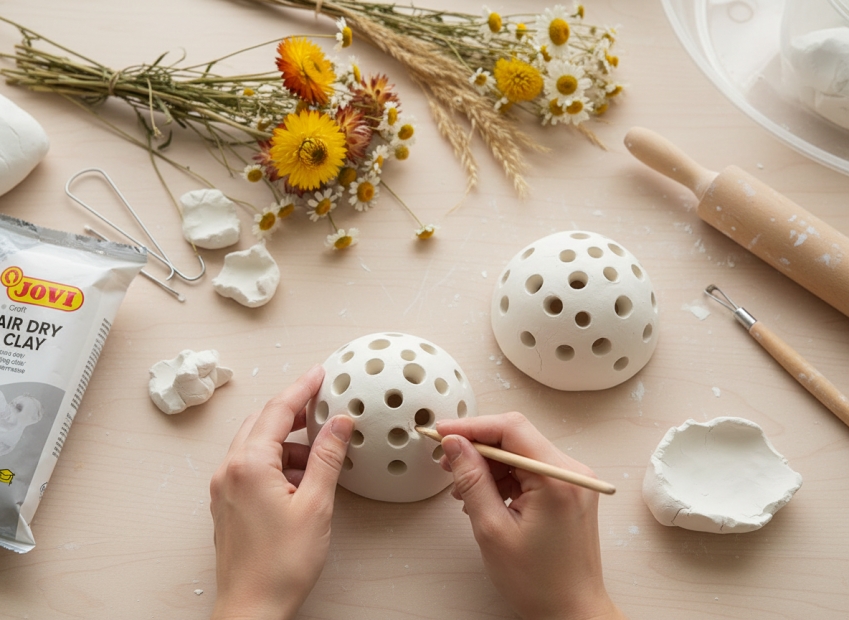
Shape a disc from clay to match the diameter of your vase or bowl. Make holes in the soft clay using a skewer or straw.
Once dried, you get a firm divider that stabilizes the arrangement without additional filler.
The half-sphere shape with holes is ideal for deeper vessels. It works as a spatial stem divider and allows airy arrangements.
A thin plate placed on the vase opening stabilizes the arrangement without interfering with the interior. Perfect solution for minimalist interiors.

Floral Frog (metal or ceramic hedgehog for stems) is a historic floristry tool now making a comeback in sustainable design.
You can use the floral frog alone or incorporate it into air-dry clay – creating a stable hybrid base for professional arrangements.
Press dried flowers, grasses, leaves, or grains into the soft clay. Relief bowls, bases, or decorative objects emerge, each carrying floristry value on its own.
The combination of air-dry clay, floral frog, and dried materials represents a modern, professional, and sustainable approach to arranging. Less waste, more control, more aesthetics, and a distinct personal style.
Florex was once essential. Today it is just one option – and the least necessary for dried flower arrangements.
Note: “Florex” is commonly used in floristry to refer to floral foam like OASIS®, which holds stems and water. For dried flowers and eco-friendly arrangements, florists increasingly prefer air-dry clay, wire grids, or the floral frog.